GEOTECHNICAL ENGINEERING
NASHVILLE
HomeSeismicBase isolation seismic design

Base Isolation Seismic Design in Nashville: What Contractors Get Wrong

Practical geotechnics, field-tested.

LEARN MORE

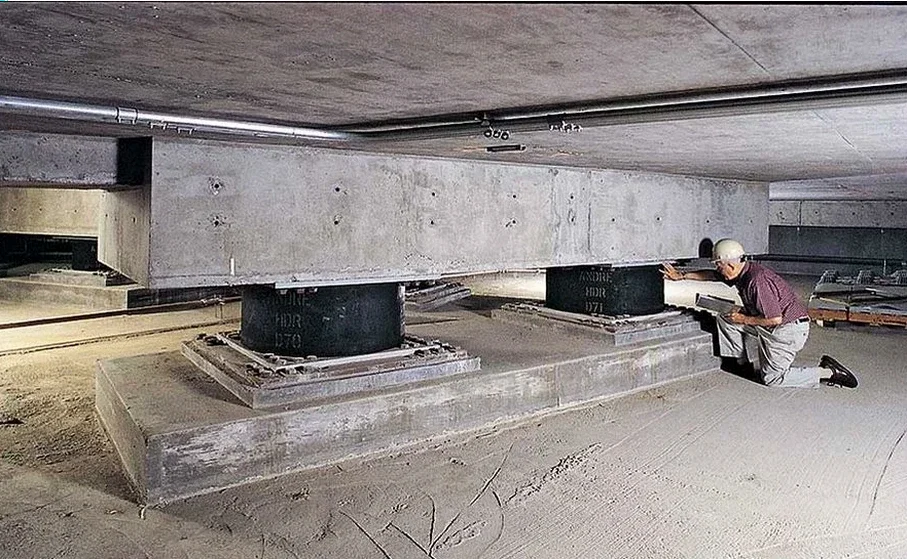
We still see engineers specifying base isolation systems for Nashville without factoring in the weathered limestone and deep residual clays that dominate the Central Basin. The logic is sound—decouple the superstructure from ground motion—but the execution often misses a critical step. The isolators sit on a pedestal, and that pedestal sits on soil that varies from stiff, pinnacled rock to compressible brown clay within the same building footprint. When you skip a detailed geotechnical campaign before locking in the isolation period, you invite unintended rocking modes and reduced damping efficiency. We have reviewed projects where the design assumed a rigid base, but the test pits revealed solution cavities and highly variable bearing strata just a few feet below the mat. In Nashville’s karst terrain, the interface between the isolation plane and the ground is where the real engineering begins, not where it ends.

In Nashville’s karst, the isolation plane is only as stiff as the variable rockhead beneath it—miss that and the period shifts.
Our service areas

Our approach and scope

The Ordovician limestone underlying much of Davidson County creates a site class that can jump from B to D within 30 horizontal feet. We routinely combine MASW surveys with rotosonic borings to map the top-of-rock profile—especially near the Harpeth River and Mill Creek corridors, where alluvial silts mask bedrock. The target isolation period has to account for this lateral stiffness variation; a single-period design across a variable site class risks amplifying the fundamental mode instead of filtering it. Our team also runs site-specific response spectra analysis rather than defaulting to the ASCE 7 generic spectrum. The deep soil sites in Nashville can modify the Memphis-sourced earthquake motions, shifting the energy content toward longer periods that may couple with the isolation system if the moat clearance is tight. When we integrate seismic microzonation data at the block scale, we can refine the isolator properties—lead-rubber or high-damping rubber—to match the actual subsurface rather than a conservative envelope. This approach has helped us avoid overdesign while keeping the superstructure elastic under the 2,475-year return motion.
Base Isolation Seismic Design in Nashville: What Contractors Get Wrong
Technical reference — Nashville

Local ground factors

Nashville sits about 130 miles from the New Madrid Seismic Zone, and the USGS hazard maps show a 5–8% probability of exceeding 0.2g PGA in 50 years—moderate by West Coast standards but significant when you consider the city’s inventory of unreinforced masonry and older concrete frames built before modern detailing. The bigger threat is the basin amplification; soft soils in the Cumberland River floodplain can stretch ground motion duration and concentrate energy in the 1–3 second range, right where mid-rise hospitals and office buildings live. A base isolation seismic design that ignores the basin resonance risks placing the isolated period atop a spectral hump instead of below it. We have seen retrofit concepts where the isolation period was set at 2.5 seconds on a Site Class D profile—the spectral acceleration actually increased relative to a fixed-base design because the basin’s dominant period lined up almost perfectly. That kind of oversight turns a premium isolation investment into a liability. Our scope always includes a basin-response sensitivity check using deep shear-wave profiles, especially for essential facilities east of the river.

Need a geotechnical assessment?

Reply within 24h.

Email: contact@geotechnicalengineering.biz

Regulatory framework

ASCE/SEI 7-22 Minimum Design Loads and Associated Criteria for Buildings and Other Structures, IBC 2024 International Building Code, ASTM D1586 Standard Test Method for Standard Penetration Test (SPT) and Split-Barrel Sampling of Soils, ASTM D2487 Standard Practice for Classification of Soils for Engineering Purposes (Unified Soil Classification System)

Reference parameters

ParameterTypical value
Design displacement under MCE (Dm)Typically 18–32 in. for 2–3 sec isolated period, site-specific
Effective damping ratio (βeff)10–30% depending on lead core size and shear strain
Minimum moat clearance1.2× Dm + 3 in. per ASCE 7-22 §17.5
Post-elastic stiffness ratio (Ku/Kd)2.5–5.0 for LRB; tested per ISO 22762 protocol
Overturning stability checkRestoring moment ≥ 1.5× overturning under 0.5g vertical + lateral
Upper-bound aging/scragging factor1.15–1.25 applied to characteristic strength per prototype test
Site class range (Nashville Central Basin)B to D; require borehole-based Vs30 per 20-m profile

Questions and answers

What does a base isolation design package cost for a mid-rise in Nashville?

For a typical 6- to 10-story building, the geotechnical investigation plus the isolation design and peer review generally runs between US$3,920 and US$8,800. The spread depends on the number of borings, the complexity of the soil profile, and whether we need to run a basin-response sensitivity study.

How do you handle the variable rock surface in the Central Basin?

We grid the footprint with closely spaced borings and use MASW lines to interpolate between them. If the rockhead drops more than 3 feet across a pedestal location, we either deepen the excavation to a uniform bearing stratum or design a transition mat that bridges the stiff and soft zones without locking in differential settlement that would tilt the isolators.

Is base isolation worth it for Nashville’s moderate seismicity?

The reference range for this service in Nashville is US$3.920 - US$8.800. The final price depends on the project scope and volume.

What prototype testing do you require for the isolators?

We follow ASCE 7-22 Section 17.8, which mandates two full-scale prototype tests per isolator type. The test sequence includes three fully reversed cycles at the design displacement, a scragging and aging protocol, and a stability check at the maximum considered displacement under 1.2 DL + 0.5 LL vertical load. We review the test reports before approving the production batch.

Location and service area

We serve projects in Nashville and surrounding areas.

View larger map