GEOTECHNICAL ENGINEERING
NASHVILLE
HomeUnderground ExcavationsGeotechnical design of deep excavations

Geotechnical Design of Deep Excavations in Nashville’s Karst Basin

Practical geotechnics, field-tested.

LEARN MORE

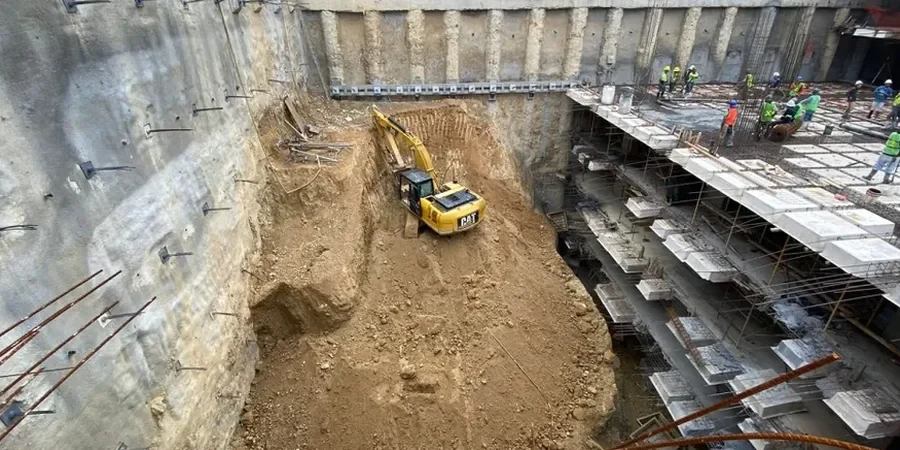
A recent mixed-use development on Church Street required an excavation nearly 40 feet deep, immediately adjacent to a 1920s masonry building. The project team discovered that the bedrock profile varied by more than 15 feet across just half the site — a classic Nashville scenario where the Fort Payne chert and Warsaw limestone weather unpredictably. In the Central Basin, deep excavation design must account for these erratic rockhead depths, along with residual clay seams that slake when exposed to air. The geotechnical design of deep excavations here involves selecting shoring systems that can handle both soil pressures in the overburden and potential wedge failures along near-vertical chert beds. A thorough subsurface investigation, often starting with SPT drilling through the clay residuum into competent rock, establishes the baseline for any rational excavation support design.

In Nashville’s karst terrain, the distance between a stable excavation and a catastrophic raveling failure can be less than three feet of weathered chert.
Our service areas

Our approach and scope

Nashville’s expansion during the post-war era pushed construction into the rolling hills south of Broadway, where cut-and-cover techniques exposed the highly variable contact between the limestone bedrock and the overlying clay-rich saprolite. This legacy means that today’s deep excavation projects frequently encounter backfill from previous construction, undocumented utilities, and solution-widened joints in the rock that channel groundwater in unpredictable ways. A geotechnical design of deep excavations in this environment integrates structural and hydrogeologic analysis, specifying tieback anchors when property line constraints rule out rakers, and designing reinforced shotcrete facing that accommodates differential movement between soil and rock zones. The design must also consider the long-term performance of permanent retaining elements, since the clay minerals in Nashville’s residuum can exert sustained swelling pressures on walls if not properly drained and backfilled with granular material.

Key considerations in Nashville’s geology include:
  • Profiling the rock surface with borings spaced no more than 50 feet apart in karst areas
  • Verifying the presence of open joints or cavities that could cause sudden loss of drilling fluid
  • Designing dewatering systems for the saturated chert rubble horizons above the limestone
  • Evaluating freeze-thaw durability of exposed shale partings in the upper bedrock
Geotechnical Design of Deep Excavations in Nashville’s Karst Basin
Technical reference — Nashville

Local ground factors

The St. Louis and Salem limestones that underlie much of Davidson County contain dissolution features ranging from centimeter-scale vugs to caverns large enough to swallow a drill rig. The single greatest risk in Nashville deep excavation work is the sudden daylighting of a clay-filled solution cavity in a shored face, which can trigger a progressive raveling failure that propagates upward behind the wall. This mechanism is particularly dangerous because it offers little visible warning before surface settlement appears. Groundwater complicates the picture further — perched water in the chert rubble above the limestone can saturate the clay fill in cavities, reducing its cohesion to near zero. A geotechnical design of deep excavations in this setting must include a solid exploration protocol, continuous monitoring of wall deflections with inclinometers, and a pre-construction grouting program to seal known karst features within the zone of influence.

Need a geotechnical assessment?

Reply within 24h.

Email: contact@geotechnicalengineering.biz

Watch the video

Regulatory framework

ASCE 7-22 Minimum Design Loads for Buildings and Other Structures, IBC 2021 Chapter 18 – Soils and Foundations, ASTM D1586 / D1586M – Standard Test Method for SPT, ASTM D2487 – Standard Practice for Classification of Soils, FHWA GEC 4 – Ground Anchors and Anchored Systems

Reference parameters

ParameterTypical value
Maximum excavation depth analyzedUp to 65 ft in urban Nashville
Predominant bedrock unitWarsaw Limestone / Fort Payne Formation
Typical overburden soil typeCH to CL clay residuum with chert fragments
Groundwater managementPerched aquifer in chert, deeper karst conduits
Lateral earth pressure modelApparent pressure diagrams per FHWA for mixed face
Design standard for seismic loadsASCE 7-22 Chapter 19 (Site Class C or D)
Typical shoring systemSoldier piles with tiebacks or internal bracing

Questions and answers

What is the typical cost range for a geotechnical design of a deep excavation in Nashville?

The engineering design package for a deep excavation in the Nashville area generally runs between US$2,150 and US$8,040, depending on the excavation depth, complexity of the shoring system, and the number of adjacent structures requiring settlement analysis. A straightforward soldier pile and lagging design for a 20-foot cut on an open site falls at the lower end, while a fully instrumented, multi-level tieback system next to a historic masonry building approaches the upper end of that range.

How do Nashville’s karst conditions affect the choice of shoring system?

Karst introduces two main challenges: unpredictable bedrock depth and the presence of clay-filled cavities. We typically specify soldier piles socketed a minimum of 10 feet into competent limestone, with the precise socket depth verified by probe holes at each pile location. If cavities are encountered, we switch to a reinforced shotcrete facing that can bridge small voids and include a contingency grouting program to fill larger features before excavation proceeds past the cavity elevation.

Can you design an excavation support system that protects an adjacent historic building?

Yes — Nashville has many unreinforced masonry buildings from the early 1900s that are highly sensitive to ground movement. Our approach begins with a pre-construction condition survey and vibration monitoring plan, then proceeds to a shoring design that limits calculated lateral deflections to less than 0.5 inches at the building line. We often use post-tensioned tiebacks with proof-testing to 133% of design load, combined with a continuous soldier beam system that minimizes unbraced span lengths adjacent to the historic structure.

What is the difference between a temporary and a permanent shoring design in Nashville?

Temporary shoring is designed for a service life of 18 to 36 months and primarily addresses construction-stage earth pressures and equipment surcharges. Permanent shoring, by contrast, must account for the long-term swelling potential of Nashville’s clay residuum, corrosion protection for steel elements in contact with the ground, and seismic earth pressure increments per ASCE 7-22. Permanent designs also require durable facing options — typically cast-in-place reinforced concrete rather than shotcrete — and a drainage system that will remain functional for the life of the structure.

Location and service area

We serve projects in Nashville and surrounding areas.

View larger map