GEOTECHNICAL ENGINEERING
NASHVILLE
HomeLaboratoryLaboratory CBR test

Laboratory CBR Testing for Pavement Design in Nashville

Practical geotechnics, field-tested.

LEARN MORE

Designing a pavement section in Nashville means accounting for two very different soil worlds. Over in West End and Belle Meade, you hit those deep, stiff cherty clays that look like they'd support anything—until they don't, especially after a wet spring. But cross the river into East Nashville or head toward Donelson, and the picture flips: alluvial silts and sandy loams along the Cumberland floodplain that can pump and rut under traffic if the CBR is misjudged. A test pit investigation into these contrasting profiles reveals why a single assumed bearing value is a gamble. Our laboratory CBR test quantifies that variability precisely, giving you soaked and unsoaked strength numbers you can plug straight into the AASHTO 93 design equation for each distinct subgrade unit on the project.

The soaked CBR value is the one that governs in Middle Tennessee—our subgrades rarely stay dry once construction starts.
Our service areas

Our approach and scope

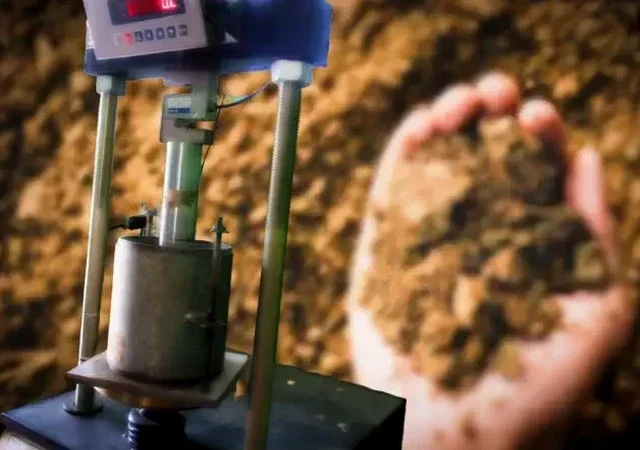
One thing we see consistently when pulling Shelby tubes from Nashville sites—especially in areas developed during the post-war boom like Green Hills—is that the natural moisture content often sits within a few points of the plastic limit. That means a modest increase in saturation during construction can drop the CBR by half or more. Our lab runs the standard ASTM D1883 procedure, but we always pair it with grain size analysis and Atterberg limits to establish the USCS classification first. The test itself uses a 3-inch mold compacted at optimum moisture, with the penetration piston driven at 0.05 inches per minute. We report both the corrected stress at 0.1-inch and 0.2-inch penetration, and we never overlook the swell measurement during the 96-hour soak—we've seen Nashville clays expand 4 to 6 percent in that period, which eats into pavement life faster than any traffic loading.
Laboratory CBR Testing for Pavement Design in Nashville
Technical reference — Nashville

Local ground factors

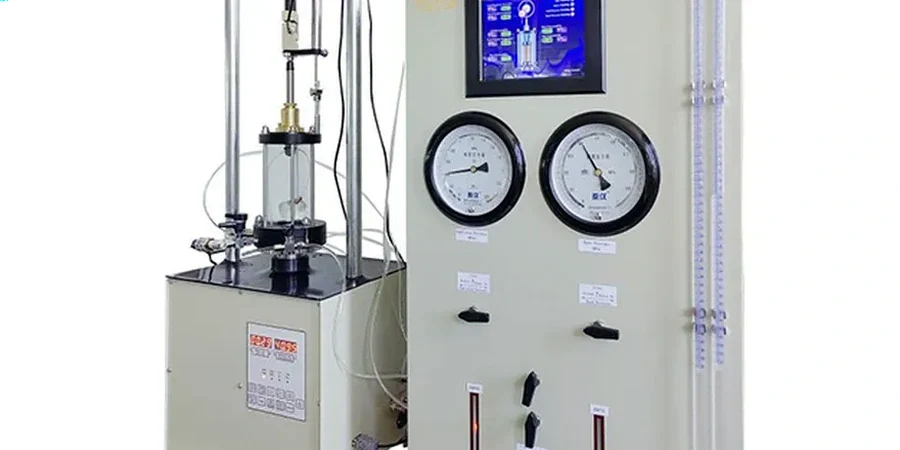
The loading frame we use in the lab is a screw-jack type with a calibrated 10,000-pound load cell, and it tells a brutal story when the sample is weak. A subgrade with a soaked CBR of 2 or 3—not uncommon in the silty terraces south of downtown—requires a structural number that can push asphalt thickness well beyond initial budget assumptions. The bigger risk isn't just the extra material cost; it's the schedule hit when the design gets kicked back because the geotech report used an assumed CBR instead of a lab-verified one. TDOT specs and most Metro Nashville pavement permits now explicitly require laboratory CBR values for any collector or arterial roadway. Skipping the lab test and running a field DCP correlation without calibration against the same soil is a mistake we've seen lead to premature fatigue cracking within three to five years.

Need a geotechnical assessment?

Reply within 24h.

Email: contact@geotechnicalengineering.biz

Regulatory framework

ASTM D1883 - Standard Test Method for California Bearing Ratio (CBR) of Laboratory-Compacted Soils, AASHTO T 193 - The California Bearing Ratio, TDOT Standard Specifications for Road and Bridge Construction, Section 207

Reference parameters

ParameterTypical value
Mold diameter6 inches (152.4 mm)
Compactive effortStandard Proctor (ASTM D698) or Modified Proctor (ASTM D1557)
Soak period96 hours submerged
Penetration rate0.05 in/min (1.27 mm/min)
Swell measurementDial gauge, continuous 96-hr record
Surcharge weight10 lb (simulates overlying pavement)
Reported valuesCBR at 0.1" and 0.2" penetration, corrected

Questions and answers

What's the difference between laboratory CBR and field CBR testing?

Laboratory CBR measures the strength of a soil compacted at a controlled moisture and density, usually after a 96-hour soak to simulate worst-case conditions. Field CBR, often estimated with a Dynamic Cone Penetrometer (DCP), reflects in-situ moisture and density at the time of testing. The lab value is more conservative and is what TDOT pavement design procedures require. We recommend running both—lab to establish the design value, field DCP to verify compaction uniformity during construction.

How much does a laboratory CBR test cost in Nashville?

A single-point CBR test typically runs between US$140 and US$200, depending on whether you need the standard or modified Proctor compaction curve as part of the package. Most projects require three points per soil type to define the moisture-density-CBR relationship, so a complete subgrade characterization for one material usually falls in the US$420 to US$600 range.

How long does the lab CBR test take from sample to report?

The physical test requires a 96-hour soak, plus about a day for compaction and penetration. Add another day for data reduction and report writing, and you're looking at 6 to 7 calendar days. If you also need the Proctor compaction curve (ASTM D698 or D1557) on the same material, that adds 2 to 3 days but can run concurrently with the soak period.

Can you run a CBR test on aggregate base material?

Yes, but with a caveat. The standard 6-inch mold limits particle size to about 3/4 inch. For larger aggregate, we use a scalping procedure per ASTM D1883 to replace oversized particles with an equal weight of material passing the 3/4-inch sieve and retained on the No. 4 sieve. The result is a valid CBR for design, but we always note the scalping percentage in the report so the engineer can judge applicability.

What CBR value does Nashville subgrade typically have?

There's no single number. The cherty residual clays common in the Highland Rim around Nashville often yield soaked CBR values between 5 and 12, which is workable for most pavement sections. But the alluvial silts and lean clays along the Cumberland River and its tributaries can drop to 2 or 3 after soaking. That's why we never recommend borrowing a CBR from a nearby project—the soil map changes within half a mile in this city.

Location and service area

We serve projects in Nashville and surrounding areas.

View larger map